H62 vs H65 vs phosphor bronze: choosing brass for socket contacts
Ask three suppliers for a socket contact in “brass” and you will get three different parts that all look the same and behave differently. The alloy decides whether the contact still grips the plug pin after two years, and it is the decision most buyers never see.
Why the material matters more than the drawing
A socket contact has two jobs. It has to carry current with as little resistance as possible, and it has to keep pressing against the plug pin while it does so. Those two jobs pull in opposite directions, and the choice of alloy is where you decide which one you are optimising for.
Almost every field failure people blame on the plastic — a socket that gets warm, a plug that no longer stays in, a scorched outlet after a few years — starts as a contact that stopped pressing hard enough. Loose contact means higher contact resistance, higher resistance means heat, and heat makes the contact relax further. The alloy is what determines how long that takes.
The three grades
H62 brass — CuZn38
Roughly 62% copper, the balance zinc. The workhorse of stamped electrical parts: conducts well, forms easily, machines and bends predictably, and is the cheapest of the three. It is the right answer for the majority of flat, non-springing parts in a socket or a power strip.
H65 brass — CuZn35
About 65% copper. The extra copper buys slightly better electrical conductivity and noticeably better resistance to corrosion and tarnishing. It forms almost as easily as H62 and costs somewhat more. Choose it where the part is visible, where it will see humidity or where a marginal conductivity gain is worth paying for.
Phosphor bronze — C5191 / C5210
Copper with tin and a small amount of phosphorus (roughly 6% tin for C5191, 8% for C5210). It is a different material with a different purpose: a much higher elastic limit and far better resistance to stress relaxation — the slow loss of spring force that happens to a metal held under load at temperature.
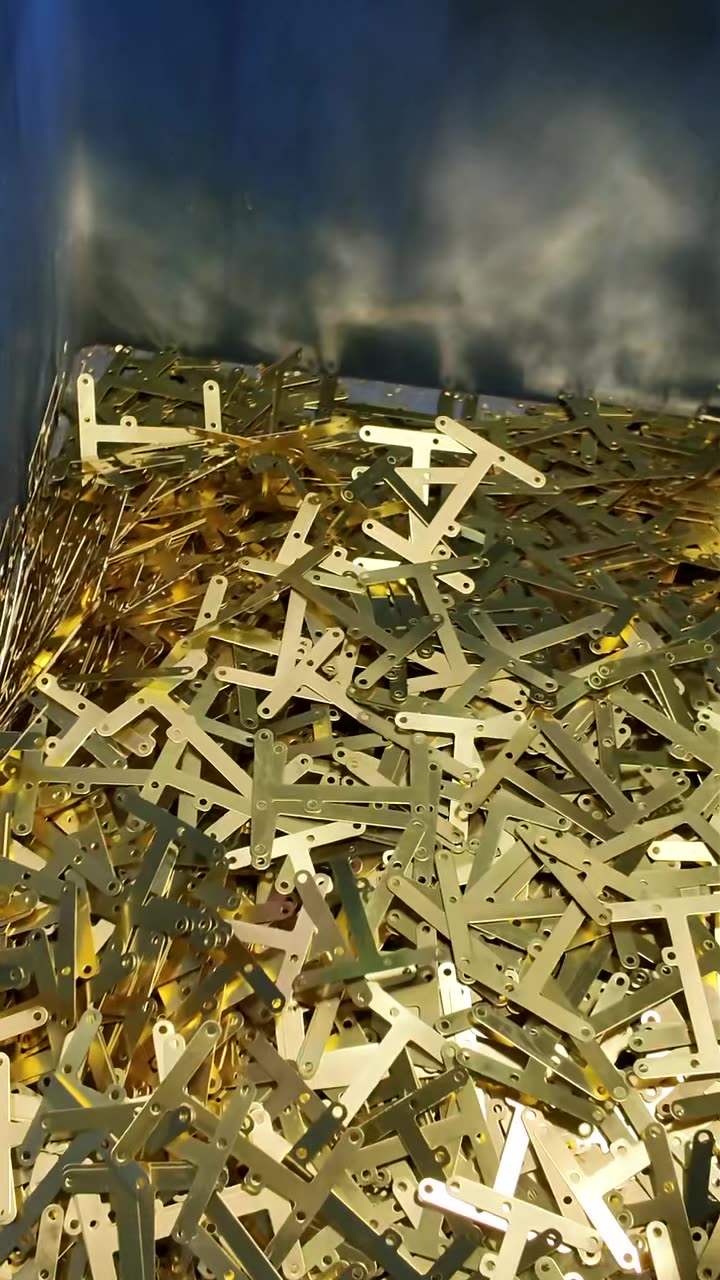
The trade-off, in one line
Brass conducts better. Phosphor bronze springs better. Phosphor bronze has roughly half the electrical conductivity of brass — and still the right choice for a socket contact, because a contact that keeps its pressure has a lower contact resistance than a brass contact that has lost its grip. The bulk conductivity of the material is not the number that decides whether a socket runs cool.
| Property | H62 | H65 | Phosphor bronze |
|---|---|---|---|
| Copper content | ~62% | ~65% | ~94% Cu + Sn + P |
| Conductivity | Good | Good, slightly better | Lower — roughly half |
| Spring / retention | Poor | Poor | Excellent |
| Resists tarnishing | Fair | Better | Good |
| Formability | Excellent | Very good | Moderate |
| Relative cost | Lowest | Mid | Highest |
Choosing by part
- Terminals, connection plates, busbars — H62, or H65 where the part is visible or exposed. These carry current; they are not springs.
- Live, neutral and earth contact clips — phosphor bronze. If a part has to be pushed apart by a plug pin and then spring back thousands of times, this is not a cost decision.
- Shuttered contacts and universal sockets — phosphor bronze, without much debate. A universal socket asks the same contact to grip several different pin shapes, which is harder, not easier.
- Pins, blades and rivets — brass is usually correct; the requirement is dimensional accuracy and wear resistance, not spring. Plating handles the wear.
- Earth clips — depends on the arrangement. In Schuko sockets the earth is a side clip that must spring, so it behaves like a contact, not like a terminal.
Two things most quotes leave out
Temper
Brass strip is supplied in tempers — soft, half-hard, hard. The grade tells you what the metal is; the temper tells you how it behaves when you bend it and how much spring it has afterwards. A part specified only as “H65” can arrive with very different forming behaviour from one supplied in a different temper, and the drawing will not tell you which you got. Specify both.
Plating
Tin plating improves solderability. Nickel plating improves wear resistance and appearance. Both are genuinely useful — and both can also be used to cover a cheaper base metal underneath. If the plating matters to your design, say so and ask for the base alloy in writing. The plating spec does not replace the material spec.
How to check what you were actually sold. Ask for the material test report for the batch, and check that the grade on the report is the grade on your drawing. A spectro report showing the copper content confirms in one line what a visual inspection never can. If a supplier cannot produce one for a shipment of parts that are supposed to be phosphor bronze, treat that as the answer.
What to put on your drawing
- Grade — H62, H65 or phosphor bronze, by name and number
- Temper — soft, half-hard or hard
- Plating — type and, where it matters, thickness
- The critical dimensions and their tolerances — not a blanket tolerance on everything
- Strip thickness and which dimension is being controlled by it
And if you are not certain which grade you need, say what the part does. “It has to hold a 16A plug pin for ten years” tells a supplier more than a tolerance block does, and a good one will come back with a recommendation and a reason.