What changes in the brass parts between UK, EU, US and AU plug standards
A socket contact is designed backwards from the plug that goes into it. Change the market and you change the pin profile, the current rating and the way the earth is made — and each of those changes the brass. This is why “the same part for all markets” usually ends in a complaint.
The standards, side by side
| Standard | Pins | Earthing | What it demands of the brass |
|---|---|---|---|
| BS1363 UK, Ireland, Gulf, HK, SG, MY |
Three rectangular pins | Full-length earth pin, also operates the shutter | Higher current rating means more brass cross-section. The earth pin doubles as a mechanical actuator, so its geometry and stiffness are functional, not decorative. Shutters add a moving interface at the contact. |
| CEE 7/7 Schuko DE, NL, ES, and much of the EU |
Two round pins | Two side earthing clips | Round pins mean the contact clip does all the gripping, and the earth clips must spring against the plug body. This is the standard where stress relaxation shows up first — both the live contacts and the earth clips need spring material. |
| Type E France, Belgium, Poland |
Two round pins | Earth pin projecting from the socket | Same contact behaviour as Schuko, but the earth is a socket-side pin rather than a clip — so the earth part is a formed pin with a mechanical job instead of a spring. |
| NEMA 5-15 US, CA, MX |
Two flat blades | Round earth pin | Flat blades put the emphasis on blade thickness and alignment: the contact must grip a flat face rather than a round one, and any twist in the blade is immediately felt as a loose plug. |
| AS/NZS 3112 AU, NZ, AR, CN partly |
Three flat pins, angled earth | Angled earth pin | The angled earth makes the insertion path asymmetric, so contact geometry has to account for the pin sweeping into position rather than entering straight. |
| Type L Italy |
Three round pins in line | Centre pin, arrangement varies by rating | Three in-line contacts in a narrow housing: the spacing tolerance between contacts is as critical as each contact itself. |
| Universal / multi-socket Export markets |
Accepts several pin types | Varies | The hardest case. One contact has to grip round pins and flat blades of different thicknesses, so the spring requirement goes up, not down. This is the last place to save money on material. |
A working summary rather than a compliance document. The current published version of the standard governs, and your certification body confirms it. Tell us the market and we build and document to the specification you give us.
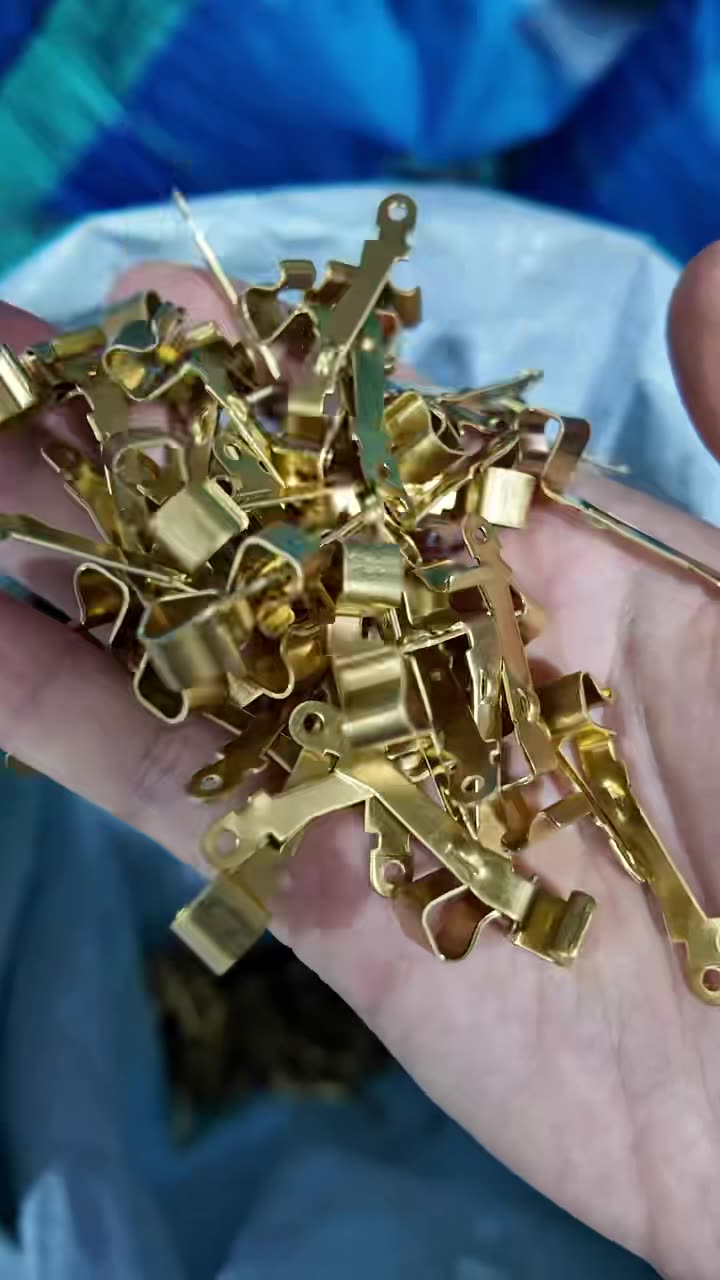
Only three things actually change in the brass
1. Contact geometry
The shape of the pin decides the shape of the contact. A round pin needs a curved contact with line contact along its length. A flat blade needs a flat gripping face and control over blade-to-contact alignment. An angled earth pin needs a contact that accepts a sweeping entry. None of these is a variation on the others; they are different parts.
2. Cross-section, because current decides it
A 13A or 16A socket carries roughly three times the current of a 6A one, and the brass has to carry it without warming up. That is a question of cross-sectional area and conductivity — which means strip thickness and material grade, not just the outline of the part. A contact designed for a low-current application, scaled up in outline but not in section, will run warm.
3. Who provides the spring force
This is the one that decides the alloy. Where the earth is a full pin and the contacts are flat blades clamped between two faces, brass can be adequate. Where the earthing is a side clip and every contact has to close around a round pin, you are relying on the material’s elastic behaviour for the life of the product. That is phosphor bronze territory.
Why multi-market parts go wrong
A supplier asked to make “one contact that works in the UK and the EU” has been asked for a compromise. The compromise is usually made in the material section and the spring, because those are the two things that are hardest to see on a drawing — and the result is a part that passes an incoming inspection and fails in the field two years later.
The safer approach is to design for the worst case in your market set and say so explicitly on the enquiry: this contact will be used at 16A, it must hold a round pin, and it must survive 10,000 insertion cycles without losing grip. A supplier given that sentence can quote the right part. A supplier given an outline drawing will quote the cheapest one that fits.
What to send with an enquiry
- Destination market and the standard the socket is designed to
- The plug or appliance standard it will be tested against — not just the pin shape you have seen in a photo
- Rated current and voltage
- Insertion cycles the product is expected to survive
- Whether the socket is shuttered, and how the shutter is actuated
- The existing part, if you are switching supplier — we will identify what it is made of
None of this is difficult to provide, and all of it changes the quote. Guessing at it is what produces a contact that looks correct and behaves badly.